
MODERATOR: I said that before, I say it again, you’re amazing. But so many people are talented, and often they’re not being discovered. You were discovered while working with Taylor Sheridan. He saw your vision. He saw your talent. How does that feel?
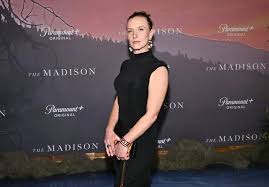
CHRISTINA: I think as an artist, especially in a form as collaborative as filmmaking, the greatest goal one can have is to find your fellow artists who like to tell stories the same way that you do, who are inspired by the same things visually as you are. So I feel very, very lucky that my path crossed with Taylor’s when it did. And I feel very, very lucky to have been on this journey with him for as long as I have.
MODERATOR: Can you please describe the different scouting locations you visited, how you selected the ones you did, and why you felt other areas didn’t work?
CHRISTINA: We scouted several ranches at the beginning of the process to find the hero locations for The Madison. I think there are about four of them that were in the final selection to really consider. And when we scouted the location we finally chose, once we dug deeper into the realms it offered, it was so clearly the right choice. There was a beautiful location to create the camp, the cabins that are sort of the hero homestead.
CHRISTINA: But also Stacy’s valley was such a character in the show that finding a place that also gave us that location in close proximity was very, very important because we wanted to create kind of a backlot for ourselves that allowed us to move from one setting to another with ease. The terrain in Montana can be very difficult to shoot in. The weather can be hard on actors. It can be hard on the crew. So we were really looking for a place that could exist as one standing location, to exist as the ranch that was one standing location, both for storytelling purposes and for visual and production purposes.
CHRISTINA: It’s one of the most spectacular locations I’ve ever had the honor of shooting in. And I was lucky enough to shoot on Yellowstone for seven years. Taylor writes very specific DNA into his scripts. I almost wish people had the opportunity to read the scripts themselves because, as a literary document, they’re really fun. He writes a lot. There’s a lot of humor in his scene descriptions, and there’s a lot of precision in how he writes certain locations.
CHRISTINA: So, we looked far and wide for Stacy’s valley, even on the enormous property that we’d already selected for the cabin location, to find the spot that really felt like the last place you wanted to ever sit on earth, it was such an important storytelling device. But also, it’s meant to feel like heaven on earth. And it was really important that the landscape, as a character in that storyline, really was as magnificent and awe-inspiring as possible.
MODERATOR: When it’s go time, and it’s time to work on these intense scenes, what do you keep in mind that keeps you focused and on the right path?
CHRISTINA: I think any story is only as good as the sum of all of its moments of truth. So, in any scene, I am always looking for truth. I’m always looking for an opportunity to help the character, the actors playing the characters, find those moments of truth. So it doesn’t matter if it’s a spectacular car chase or explosion on Yellowstone, or if it’s seven people at a dinner table in The Madison. It only really resonates with an audience if you find the truth in that moment.
CHRISTINA: So, I am looking every day for sort of the simplest breath of authenticity through every scene that we can find. And I try very hard for the cast to kind of create a space where we can let everything else fall away, as complicated or as simple as a scene may be, to really focus on it one step, one word, one feeling at a time.
MODERATOR: Can you decipher the secret of the magic and success of his series? And how is The Madison different from the other series you have directed for him?
CHRISTINA: You know, Taylor is sort of a unicorn to me. His ability to sit down and write a story from start to finish, he doesn’t do revisions, he doesn’t go back and rework things. His storytelling kind of moves through him like a storm. And it’s remarkable to be on the receiving end of those scripts. I think at the end of the day, and this might be a slightly controversial thing to say, I think Taylor writes his stories for audiences and not for critics.
CHRISTINA: I think he tells stories that are grounded in stories that have resonated with him. And I think there is a playfulness with which he explores themes that are often considered somewhat polarizing and explores them kind of from a place that asks questions. I think part of the reason I gravitate so much to his work is I feel like the scripts are always asking questions of the characters, of the audience, of the director.
CHRISTINA: And the process of answering those questions is what makes the stories compelling to me. I think The Madison is different from his other work in that it is profoundly intimate. It is really relying on emotional explosions rather than technical ones. I think he has really given the cast of the show a lot of runway to make these characters their own and to allow the internal human landscape to take the place of sort of the vaster frontiers of Landman or Yellowstone. And it’s been very satisfying to be able to work in that more intimate space on one of his shows.
MODERATOR: What was the most challenging scene to execute and why?
CHRISTINA: You know, the scene I keep coming back to is there’s a scene in episode four where Michelle has this very emotional moment in a river and literally submerges herself in the water. I remember waking up that morning and being really scared about our ability to do the scene that day because it was so cold. The water was cold, the weather was turning. And to be able to access that kind of deep emotional place whilst also dealing with being in frigid cold water and, you know, you can do one take that way and sort of relax into it and let the moment be the moment.
CHRISTINA: It was a long scene, and there’s a scene by herself, and then there’s a scene where her friend Liliana comes to join her. So it was a significant portion of the day in that river, and it was a massive feat on her part, on the part of the costume department, for giving her a wetsuit underneath her wardrobe, for the stunt team and the special effects team to create a space for her where she felt safe in the river. But it’s somehow easier to do really big technical feats of cinematic flashiness than it is to do something that’s really emotionally pure under very difficult physical conditions.
CHRISTINA: And I credit Michelle for that scene being what it is. Her laser focus and her commitment to the heartbeat of her character in that moment is, I think, what makes that scene so spectacular.
MODERATOR: Could you talk about the Montana and Colorado locations where you shoot the series? What kind of natural landscape were you searching for?
CHRISTINA: We did not shoot in Colorado. We shot in Montana, and we shot in Texas. We shot mostly interiors in Texas and some of the interior New York work in Texas. I think in all of Taylor’s shows, there is an element where the landscape is very often a main character. Certainly, in Yellowstone, it was the main character, and in Madison, it is as well.
CHRISTINA: It is almost the other part of the relationship that is between Stacy and Paul is this place that she comes to, and in coming to, understands a part of him that she didn’t know before. And so it was very important that the landscape be representative of a great love, of Paul’s great love for the space that then becomes Stacy’s great love for the same place. It was important that it felt like a place worth traveling to, worth making big decisions about.
CHRISTINA: And I think the grandness, but also the very nuanced beauty of all these different facets of those locations, were very important in terms of making it such a center point of the storytelling.
MODERATOR: Can you tell us your relationship with nature and how important it is to you? It seems pretty strong after Yellowstone and this series.
CHRISTINA: You know, when I was little, I grew up in love with nature and the outdoors. I grew up in the suburbs and, you know, I got to go to the beach in the summer, and escaping the city and escaping the urban world always felt like such a gift to me. And then I proceeded to live in New York City for 15 years and convince myself it was less important to me than I think it really was. And in my pursuit of storytelling in film and television, I got brought back out to nature through Yellowstone, but also through other projects that I did in Mississippi and in New Orleans.
CHRISTINA: And so, it’s a very important part of who I am. Animals are a very important part of who I am. My husband is an animal coordinator. He does a lot of the animal work on Taylor’s shows, so we’re constantly surrounded by wide-open spaces and lots of animals. And I think animals and, you know, the landscapes of nature obviously go hand in hand. So getting to work in a space where I am allowed to use landscape as a storytelling device and animals as characters is, you know, the greatest gift of my career.
MODERATOR: Next question is from Ayala Or-El from Israel. You’ve, of course, already spoken a lot about the landscapes and stuff, but she has a very interesting new take on them. The Montana setting feels like a character in itself. How did you use landscape, silence, and pacing to reflect the inner lives of the Clyburn family?
CHRISTINA: You know, there’s something really interesting about nature, which is it can make you feel very alone, and it can also make you feel very connected to the place, but also to the people that you share the place with. So there was a lot of thought during my prep that went into what is happening in every moment. Where is nature an adversary? Where is it a welcoming mother? Where is it something that sets us apart from each other?
CHRISTINA: And where is it something that brings us together? So, you know, there was a lot of attention in the beginning in the way we shot it, in the way that we used color and color correction to make the landscape of the ranch when the Clyburns first discover it feel very different through the eyes of Stacy and the kids than it did through Preston and Paul’s eyes. It’s a little bit more barren, it’s a little brighter, it’s a little more inhospitable. And then over the course of the series, the goal was to allow the place to become more and more magical as they begin to form a connection to it.
MODERATOR: The series is dedicated to Robert Redford. Could you talk about that decision and how his work influenced the tone and storytelling of The Madison?
CHRISTINA: The decision to dedicate that episode to him was entirely Taylor’s. I will say, as somebody who came up through independent filmmaking, who has been a fan and someone with deep reverence for Redford’s work as an actor, as a supporter of storytellers, as a storyteller, as an incubator of talent in this discipline, I think anyone watching the show will understand why it was dedicated to him, or at least one of the reasons.
CHRISTINA: I think the kind of storytelling that he embraced and supported throughout his life is, you know, the kind of thing that I — I would not be telling this particular story if I had not been influenced by him myself as a young artist and through my career as a filmmaker.
MODERATOR: You’re working with actors like Michelle Pfeiffer and Kurt Russell, who bring so much history and presence with them. As a director, how do you create space for performances that feel this intimate while still shaping such a specific emotional world around them? And what, if anything, surprised you most about working with them?
CHRISTINA: I would be lying to say I didn’t show up to the beginning of this process without a little bit of nervousness. Obviously, you know, it’s Michelle, and it’s Kurt, and they are icons and artists that I have admired my entire career. So, you know, the reality is they are who they are and have the careers that they have had, not just because they are incredibly talented individuals, but because they are so committed and because they treat every day on set with the same precision, ferocity, and nuance that they have approached anything in their entire careers.
CHRISTINA: That’s what makes them exceptional, right? There’s the innate talent, but there is also the divine dedication that they have shown throughout their lives to what their art is. And this show is no different. You know, working with Michelle, especially, she is very hard on herself. She is very driven. She is incredibly disciplined and incredibly precise in the way that she does the work before she shows up onto set.
CHRISTINA: And then it becomes about creating a space where actors feel safe enough to let go of all the work that they’ve done and allow themselves to fall into it and know that you will catch them if it goes too far, you will push them if it doesn’t go far enough. I would not be able to do my job if I had not been offered that trust and collaboration from Michelle, Kurt, and the entire cast. So, it was a great honor to be able to find a space collectively between all of us where we all felt safe, not always having the right answers, not always knowing where the edge is, and together bringing ourselves to that place.
CHRISTINA: I think the performances in this show are remarkable. I think that it is very much testament to the deep trust, not only between Michelle and Kurt and the cast and myself, but the trust that they built within their relationship to each other. This cast very much became a family over the course of the first year and into the second season. And on and off screen, Michelle is the matriarch of the Clyburn family. And she was also our matriarch on set, sort of the mother that we were all trying to live up to and take care of at the same time.
MODERATOR: The Madison is a series where cinematography plays a very important role. Did your background as a cinematographer help you direct with a stronger visual vision, especially in creating such carefully composed shots where nature and people almost feel like painted canvases?
CHRISTINA: Well, thank you. Those are very beautiful words about the show. I do not take them lightly. I began as a cinematographer, but I have been directing and shooting my own work in TV space. For the last six years, I’ve shot, I don’t know, 30-odd episodes of television that I’ve directed. So for me at this point, the two are hard to separate because my shorthand with myself when I am directing and shooting is all sort of tangled up into each other.
CHRISTINA: I am only able to do that by virtue of the unbelievable crew that I’ve been working with for a very long time that can read my mind, that understand how I tell stories, how Taylor tells stories. I can only do it with the editors that we have working with us who understand how to decipher all this footage that they’re getting and know what my intent is. So I think of every story as a storyteller when I go into it, but it’s hard for me to parse what is my directing mind and what is my cinematographer’s mind because they’re both kind of working in tandem.
MODERATOR: My feeling is Taylor Sheridan really writes the way he wants, very intuitively and on a human scale without thinking of any kind of format or formulas, which is pretty remarkable. Would you agree?
CHRISTINA: I do. I think Taylor writes story. I don’t think he writes with a certain act structure in mind. I don’t necessarily always think he necessarily knows where something is going. Um, he writes from his heart. He writes from things that inspire him, conversations that have stayed with him, and people who intrigue him. And it’s not like he writes an outline and then polishes it. It comes out fully realized.
CHRISTINA: I mean, when we did 1883 together, I think we got one script on a Wednesday, and the next one on a Saturday, and the following one on a Thursday. I think he percolates for a long time, and the story brews in him, and when he sits down to write it, it just comes out like a wildfire.
MODERATOR: The series treats grief sometimes in a very quiet, almost internal way. What did you learn about grief while making this? Was there something that surprised you about how people actually process loss?
CHRISTINA: You know, this story was very close to me because I lost my father 10 years ago, and was a daughter to my mother as we were navigating that as a family. I think one of the things that it reminded me about grief is that grief isn’t always sad. Sometimes it’s absurd. Sometimes it’s hysterical. Sometimes it’s quiet. Sometimes it’s unhinged. It is this very rapid modulating between extreme feelings as we are trying to find our equilibrium.
CHRISTINA: And I think it was important in the story to be able to touch on those different notes because if you were just consistently, you know, in grief as deep sadness, it doesn’t feel as sad, it doesn’t feel as real. There are incredibly absurd, funny things that happen when people are living in this very, very heightened, very undone place. And I think the story does a very good job at touching on all of those different modulations that happen when you are in this extreme state of loss.
MODERATOR: Mm-hmm. I personally also felt it was very authentic the way grief was described in this series. I want to ask two more personal questions. I mean, for myself. One is Autumn Durald Arkapaw, who just won, not just an Oscar for cinematography, but it’s the first woman to win an Oscar for cinematography. Can you talk a little bit about how much that means to you personally at your stage in your career?
CHRISTINA: I cried when she won. I’m sure I was not the only one. It could not be more deserved. It could not be far past the opportune moment for it to happen. I mean, it’s sort of crazy when you look at how many women are telling stories in film and television, that it’s taken this long for that to be recognized and for women to be championed in the world of cinematography. I could write a dissertation on what it means to be a female cinematographer, finally seeing that praise lauded on one of our own.
CHRISTINA: I wish it had happened a long time ago. I’m so glad that it happened now, and my heart is full. I think Autumn is beyond deserving and it’s such a beautiful moment. I will say that you know, what I think of when I see pictures of her holding that Oscar is the number of young women who may not even realize they want to go into this field yet, having that on their radar. You need to see something to know how to be it sometimes.
CHRISTINA: And for those of us who have been female cinematographers, you know, on our sets, we work with female cinematographers all the time because there’s only one of us. And, you know, but I think that the fact that it is something that is not going to be unique in the future. I hope it is something that is not going to be unique in the future because women deserve to be behind those cameras with those cameras on their shoulders, holding those Oscars as much as their male counterparts.
MODERATOR: What do you hope audiences feel or take away from The Madison? And two, the next project, which is going to come out soon as well, is the Dutton Ranch. And can you tease a little bit about what we can look forward to? I think it’s going to be nice.
CHRISTINA: Those are two very different questions. I hope that The Madison can bring people comfort and catharsis. I hope it is something that people can see themselves in, their mothers, fathers, sisters, or friends in. I think we live in a society where differences are often highlighted more than the things we have in common. And I think grief and loss are universal, revealing how much we share as human beings, regardless of where we live or what we believe.
CHRISTINA: And I would like to think that maybe meditating on that is something that would be good for all of us at this point in time. As far as Dutton Ranch, I am very, very excited for that show to come out into the world. We’ve been working very hard on it for some time now. I have been blessed to be part of the Yellowstone universe since the first season, and it’s a real honor to be asked to help carry on the story. I would walk through fire for Kelly Reilly and Cole Hauser. They are a brother and sister to me, and it is a real honor to continue telling the story of Rip and Beth with them.
MODERATOR: On that note, thank you so much for taking the time to speak with us today, Christina. And everyone, please stay up, because Michelle Pfeiffer is going to join us next. We will be right back. But in the meantime, bye.
CHRISTINA: Thank you so much.
Sarah Knight Adamson April 6, 2026