
MODERATOR: It is a true honor to welcome an artist whose presence on screen has defined decades of extraordinary storytelling. Today, she joins us in a powerful new chapter with The Madison, where her performance anchors a story that is visually striking as it is emotionally resonant. Her ability to inhabit complex characters with nuance and authenticity makes her the perfect force at the center of the series. Please welcome the exceptional Michelle Pfeiffer. Welcome, welcome. Thank you so much for being here.
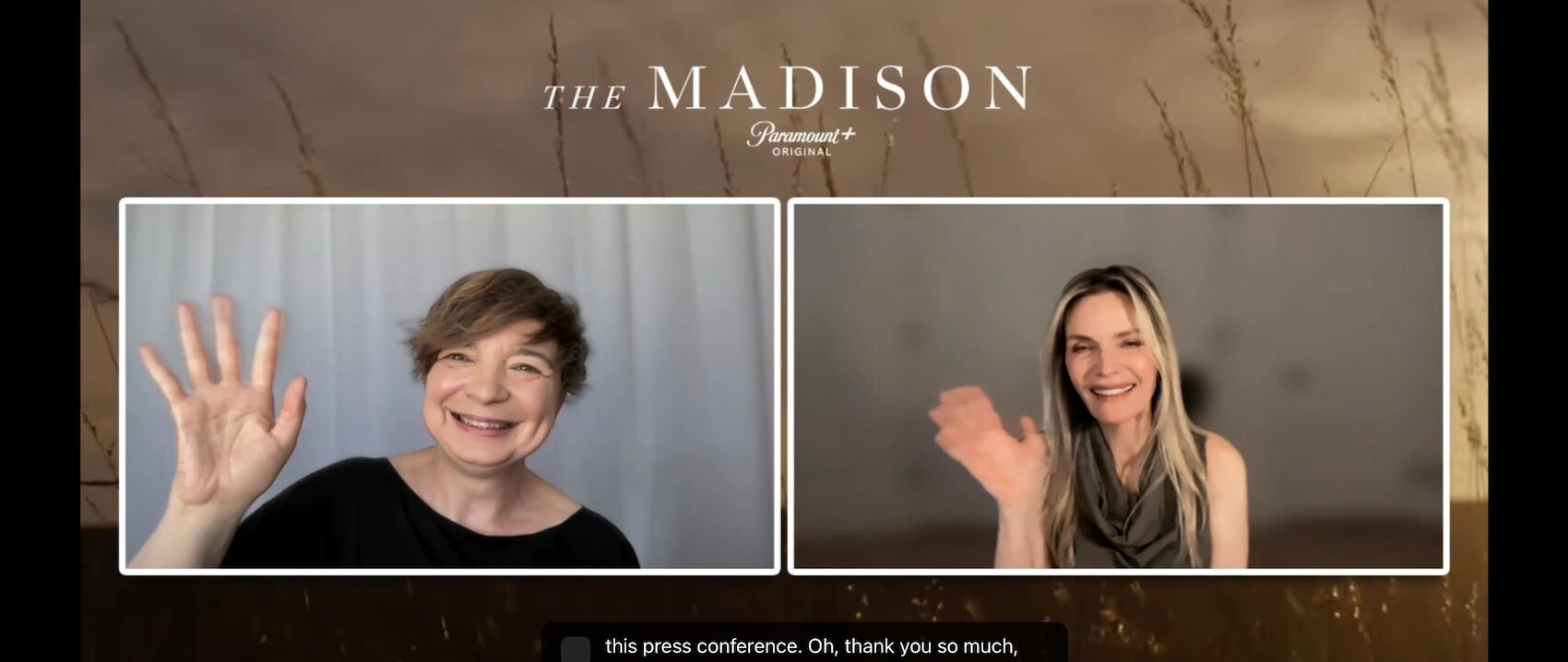
MODERATOR: And I have to say, I love the show. It’s very personal to me, especially on how authentic grief is portrayed. But my first question, actually, I would like to direct into something else, into what the show is also about. About love and being in the presence of your life, not thinking about the past or the future, but be present for the people you love. Who is your anchor in your life, or what is your anchor in your life that kind of does that for you?
MICHELLE: Well, my husband, David. And my children. I think since I became a mom, I found a balance in my life. And, you know, being an actor when you’re forced to be introspective all the time, and sort of study yourself from the outside looking in, it’s a relief to finally have something in your life that can take you out of your narcissism.
MICHELLE: And it just gives your life a different level of meaning.
MODERATOR: Can’t ever imagine you had narcissism. You are so grounded and always have been.
MICHELLE: I mean, it’s just the nature of the beast, you know? There’s an inherent narcissism that one has to have. You know, I mean, also, you’re looking at yourself up on the screen all the time. And, you know, it’s all this. It’s all this. And people are saying things about you.
And you’re trying to connect with your character so that lends itself to you needing to, you know, be retrospective more than most people might be. And sometimes it can cross into a place where it just is not healthy.
MODERATOR: Stacy is reprocessing her entire marriage through what she’s discovering about Preston’s life in Montana. Did you approach that as a regret for what she didn’t share with him, or as an expansion of their love story where she’s still present for what he left behind?
MICHELLE: I think it’s both things at play. And we have to remember that we’re seeing Stacy through the first six days of this unspeakable, shocking tragedy. And then there’s this discovery of the love of her life, the only man that she’s ever loved. There’s a whole side to him that she didn’t know about that he was begging to share with her and with their children.
I think there is a tremendous amount of regret that is working on her. And then there’s this insatiable curiosity, you know, to discover this side of him that she never knew. And it’s a lot about holding on to him.
MODERATOR: The first season takes place in one week. How was it for you to live in such an intense, emotional state throughout the shoot?
MICHELLE: Exhausting. [laugh] And I felt really envious of the rest of the cast because, you know, they would have social gatherings on the weekend, or maybe, you know, in the evening, and I was never able to participate. And I love them so much. And they’re such great humans that you want to spend time with. And we all grew really close.
But what it did was, it forced me, because it was so much, to make a conscious decision to let it go at the end of the day and on the weekend. Although I also had to work [laugh] for, you know, upcoming scenes and preparing for the work ahead. And so that’s how I spent most of my weekend. But I tried to not give myself permission to actually live in it. I think for me, that is not my process.
MODERATOR: What scene was the most challenging for you to perform?
MICHELLE: I think the question is, which scene wasn’t? [laugh] They’re all pretty challenging scenes. And, I mean, they’re all challenging. But I would say the scenes where we were actually struggling with the elements where the wind was, you know, 60 miles per hour. And, you know, the flags and the lights were tipping over. And you had crew members, like, laying on the key lights. And your hair was just all over the place. And the poor hairdresser’s just trying to keep some control over it. I mean, all of that just becomes so distracting, and also really stressful for everyone around trying to just do their job.
MODERATOR: Can you please share your feelings when you first read the script?
MICHELLE: Well, when I first read it, and I saw the places I had to go throughout, I thought, “Oh, my. How am I going to do this? How is this sustainable? I’m going to have to really pace myself.”
But, you know, it’s incredibly moving. The love affair between Stacy and Preston is one that we all hope to find. I mean, it’s a fairy tale in a way, but some people have those fairy tale relationships. And it’s the only love that she has ever known, which is why it’s learning how to rebuild after everything you have known just falls apart.
And also, how to be there for her family. And what it does to the family dynamic. And some of it is beautiful and brings you closer together. And then there are times where it just pulls you apart and it’s very painful.
MODERATOR: Can you talk about the process of creating the duality within your character, and the challenges of having so much introspection going on internally one moment, and then having moments where you can externally express what you’re feeling?
MICHELLE: Well, I was always looking for those moments that could be more internal. Because there is a concern that it’s just too much. You know, it’s just too much raw emotion for the audience. And they are going to need relief. But that’s why the comedy is so beautiful. You know, this story, it’s raw and it’s tender. It’s visceral. And then at times, it’s unexpectedly funny.
And I really admire my fellow actors and this cast for giving us those moments. Because it’s also a really hard tone to find. That humor is really anchored in reality because it can’t become too broad. And so that you don’t sort of take your audience in and out of the story and the tone of the story.
And my hat’s off to Christina Alexandra Voros because she really helped to orchestrate those tones. And so they all sort of beautifully and seamlessly go together. And I think it’s one of the hardest things to do.
MODERATOR: This marks a return to TV after a significant time. What was it about this series that made you want to come back to TV?
MICHELLE: Well, I did do First Lady a few years back. I guess it’s been, I don’t know how many years now, maybe three years. But yes, it is the first time in decades, many decades, that I have done episodic television. And I just think the quality of the work, the quality of the material that I’ve been seeing on television, I’ve been so envious of. And for a while now, wanted very much to be a part of it.
And, you know, Taylor Sheridan has an amazing track record. And when I met with him, I love the way he spoke about this character and the love story element and the family dynamics. And I thought it was just such an interesting concept, and I felt that the way he spoke about Stacy, she was someone that I could relate to.
MODERATOR: What have you learned about grief from doing the show, and what did you yourself bring to your character in terms of your own experiences with grief?
MICHELLE: I think when you get to my age, you know, you’ve had enough people close to you, friends, family, colleagues, pass away. And so you don’t have to look too far for inspiration for that, unfortunately. But I realized too in thinking about grief, you know, because it’s really incredible, the feedback I’m getting from people. Old friends and, you know, colleagues and people that I know in the industry. And from all walks, you know? And how moved they are. Some of my snootiest friends have called me telling me how much they like the show, and I’m like, “Are you crying?” [laugh]
And what’s really surprising is how much it affects men. And how it resonates with men. And, you know, maybe it speaks to grief in a way that they’ve experienced but haven’t really been able to express. And maybe it takes them by surprise. And then there are all different ways and things to grieve about. People have lost their homes in a fire. People have lost jobs that they expected to retire in. You know, loss is a really universal experience.
MODERATOR: Do you consider yourself a city mouse or a country mouse?
MICHELLE: I’m a little of both. But I would be more city house. I’m probably 70-30. You know, I love New York City. I love Los Angeles. But I like getting away too for periods of time. But I still need a little stimulation in my life.
MODERATOR: How does it feel to be part of the Taylor Sheridan universe?
MICHELLE: Well, I love working on this. And I love the cast that he has assembled. I love the scripts that he has written. You know, I didn’t know any of these actors before I started, and I remember on the first day I was a little bit nervous because we were all together in a car the very first day, and everybody’s a little nervous, and still trying to find their way through the material and discovering who this character is that they’re playing. And I’m really grateful that he’s given me this opportunity and that he trusted me to tell this story. I think it’s a very important one for him.
MODERATOR: What would you personally need to make that kind of life work, and how long do you think you really could stay there?
MICHELLE: I would definitely need a real bathroom. Other than that, some coffee and a real bathroom and I’m good.
MODERATOR: As this show streams on the small screen across the globe, can you please talk about your relationship to television? How much does TV play a role in your everyday life, whether it be for news, drama, or laughs? What shows do you enjoy? What’s your guilty pleasure?
MICHELLE: For me, feel like my guilty pleasure these days is the news. I don’t watch a lot of TV. Not because there isn’t a lot of great stuff on, ’cause there is. And I just forget. Always forget. We’ll sit down and say, “What should we watch?” And I’ll forget the shows where I said, “Ooh, I have to watch that.” I’m actually just getting caught up with Severance now, which I’m really enjoying. I’m watching The Pitt. I’m also very excited about Margo’s Got Money Troubles coming out in April.
MICHELLE: David and I watched The Madison. You know, I’m really proud of it. So yeah. What else am I watching? And I haven’t really had time lately to watch a lot of television. I like a good documentary.
MODERATOR: Your character has a line in the first episode when she tells her daughter that she and her husband have never had a fight during their entire marriage. Do you think that is possible in a relationship, and what were your initial thoughts when you read that line
MICHELLE: I think it’s how you define fight. And she does say, you know, “We walked right up to it.” You know, I think there have been heated discussions. But I think what she means by that is there was never a moment where there was any question that they wouldn’t be together.
MODERATOR: Do you feel the TV series are the only place these days where actors can find interesting roles and more character-driven stories?
MICHELLE: No, but I feel like there is more on television at the moment.
MODERATOR: What do you think makes this character unique out of the characters that you have played?
MICHELLE: I think, well, they’re all unique. They’re really very different, and they all require that I take different approaches and a different approach to discovery of who they are. A different skillset, if you will. I think this one took more, oh, I don’t know, vulnerability than feeling more exposed, feeling more raw.
The only way I was able to do it was, first and foremost, with our director Christina Alexandra Voros. I trusted her implicitly from the beginning, and I knew whatever I laid out there, she was gonna take care of it. And then the cast and the crew, you just felt cocooned by all of that. I mean, they all saw. I could feel that they all saw where I had to go.
MODERATOR: You joined The Madison without having read a full script, trusting Taylor Sheridan’s vision and the recommendation of colleagues like Helen Mirren. How did that decision influence your connection with your character and shape the way you approached such an intimate story about grief and personal?
MICHELLE: Okay, well, I wouldn’t say that decision shaped the way I approached it. First of all, I didn’t read a word. Not only did I not read a full script, I didn’t read a word.
And as in television a lot of the times, the scripts come kind of very close to shooting. And that was also the case here. So there wasn’t a lot of time to do my typical preparing. Which I think was a blessing. In this case, I was forced to just work more instinctually. And I can get in my head sometimes. And I try to, you know, try to plan things out, and there was just no room for that.
And I also think it allowed me to show up and just be present and trust the words, and trust, you know, what was going on, the dynamic in the scene, and let things happen. Not plan things. Because there was really no other way to approach it. And I think that was the right approach.
MODERATOR: Do you think this series is a lesson in how to navigate grief and resilience? And how do you think a show like this can help the viewer that might also be going through the process of grief?
MICHELLE: I think what we see in the show is that people deal with grief, and grief manifests itself differently with everyone. Some people are very stoic and they’re very internal about it.
And some people, it’s just all out there. And when you combine grief and the shock of an unexpected tragedy, it’s a different kind of grieving. And then there’s almost a PTSD thing that also comes into play. And sometimes in the case of Abby, my eldest daughter, she’s holding it together more because she sees what a mess I am.
And she realizes she’s the next in line. She needs to hold things together so that I am allowed to grieve. And, you know, the best and the worst comes out in people when there is such a shocking death and loss in the family.
MODERATOR: The flashbacks in the story feel like a conversation in the present. Why do we talk to those who have passed away? Is that something you do and does it bring you peace?
MICHELLE:– That’s actually a beautiful question. I think it speaks to hope. I think it speaks to hope that they’re okay, wherever they are. That they are still there. And it speaks to a need to connect and stay connected to those that we’ve lost. And that somehow, because they’re not here anymore, they’re up there and they have a wisdom that we don’t have. And asking for their guidance.
MODERATOR: The Madison marks your first on-screen reunion with Kurt Russell since the 1988 film Tequila Sunrise. After 38 years, what changes have you noticed in Kurt over time, and what was it like working with him for this series? Did you two reminisce about old times?
MICHELLE: He has not changed one bit. And I’m so happy. I have such fond memories working with him. And he was such an amazing ally of mine. And just my big brother by my side. If I ever, you know, was struggling with anything, he was there. He’s like the court jester, you know? He’s just always so up and so positive, and so supportive. And he was exactly the same here. And he still has those same dimples, you know, that are amazing. So yeah. No, I was so happy that we were actually able to finally secure him because of his scheduling issues.
MODERATOR: Coming from a New York background into the vast isolating landscape of Montana, can you talk about how your transformation over the course of the series? And what does that environment unlock in her and you emotionally?
MICHELLE: Remember, the series takes place over six days. So there’s not a huge arc. She’s just struggling to stay alive. She is just hanging on and trying to cope with the loss of the love of her life. And when the bottom has fallen out of everything she has known, how to rebuild. How to protect her family. And just struggling with this enormous, unfathomable loss and this grief.
MODERATOR: Can you talk a little bit more about your relationship, or Stacy’s relationship to her children? I find very, very interesting for you as the mother having these kids.
MICHELLE: Well, I think that she and Preston, like a lot of parents at the end of the day, you know, are just questioning and second-guessing the way they brought their children up. And did they do justice? Are they overprotective? Are they, you know, under-protective? And what are the right next best steps to sort of try and usher them into adulthood?
MODERATOR: So thank you so much all for joining us today, and for all your wonderful questions. All six episodes of season one of The Madison are now available on Paramount Plus.
MICHELLE: Oh, thank you so much. And thank you, everyone.
April 4, 2026
Sarah Knight Adamson
us.